10 Key K-Beauty Ingredients for 2026 | From PDRN, Exosomes and Azulene to NAD and NMN
By URITRIP
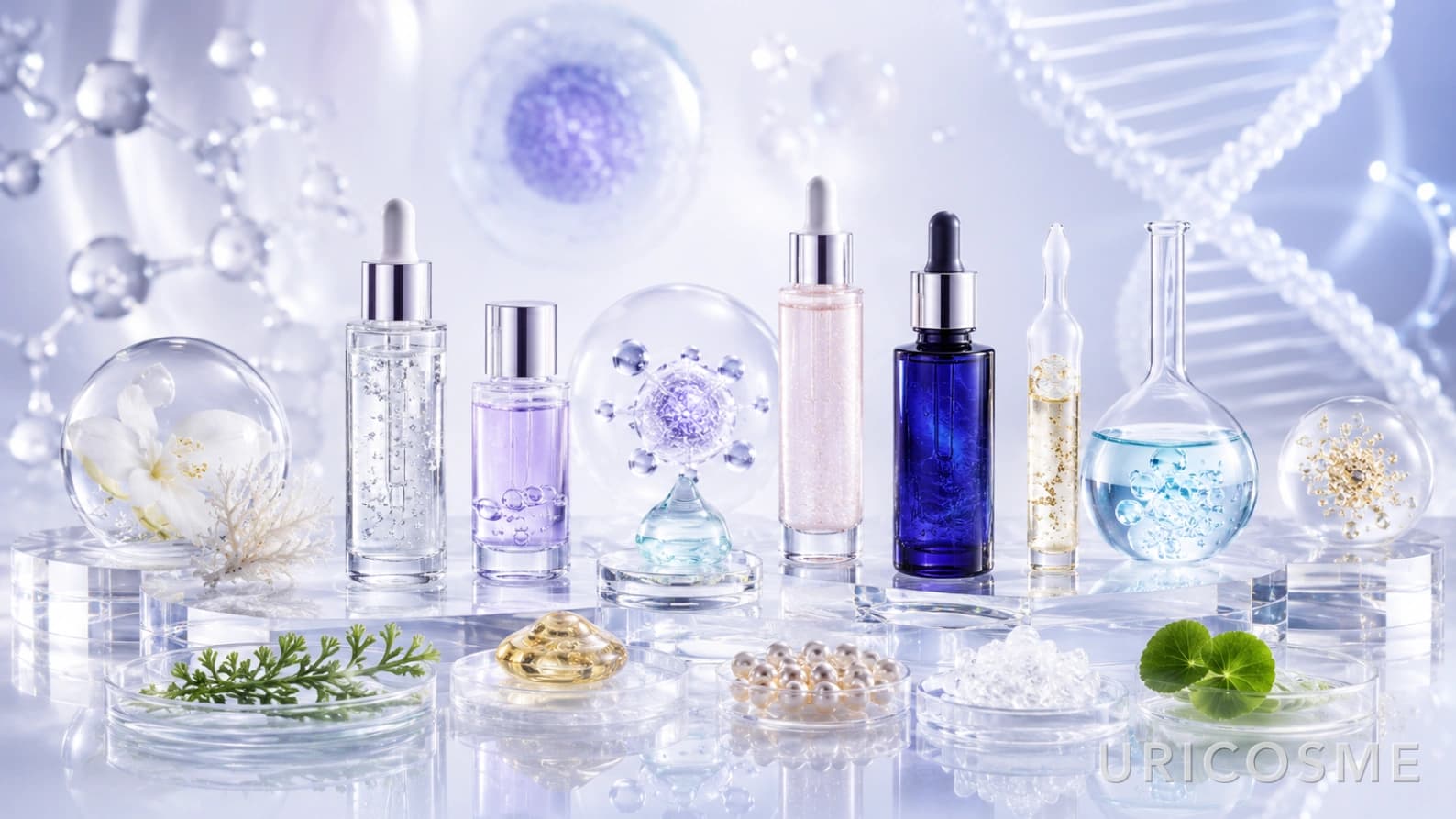
In 2026, the focus of K-beauty is shifting from “anti-aging,” which aims to erase wrinkles, toward “slow aging,” an approach centered on maintaining skin condition and the skin barrier over time.
Ingredients first associated with professional treatments, such as PDRN and exosomes, are moving into at-home skin care. At the same time, calming ingredients including azulene, madecassoside, and fermented extracts are gaining attention. New delivery technologies and longevity-inspired materials, including spicules, biomimetic peptides, NAD, and NMN, are also entering the market.
2026 K-Beauty Trends: Slow Aging Over Anti-Aging
Slow aging does not mean stopping skin aging altogether. Rather than layering several strong actives for rapid change, it emphasizes consistent hydration, barrier care, sun protection, and antioxidant care.
The 2026 K-beauty ingredient landscape can be divided into three broad directions.
- Skin conditioning: PDRN, exosomes, and biomimetic peptides
- Calming and barrier care: azulene, madecassoside, and fermented ingredients
- Antioxidants and delivery technologies: glutathione, ginseng, spicules, NAD, and NMN
10 Key K-Beauty Ingredients for 2026 at a Glance
| Ingredient | Key feature | Best suited for | What to check |
|---|---|---|---|
| PDRN | Skin conditioning and elasticity care | Dryness, loss of firmness | Topical products do not work the same way as injections |
| Exosomes | Inspired by cell-to-cell communication | Elasticity, overall skin condition | Source material and stabilization technology |
| Azulene | A blue-toned calming ingredient | Visible redness, sensitivity | The full formula, including fragrance and alcohol |
| Madecassoside | A soothing component derived from centella | Dryness, weakened barrier | Do not directly compare its amount with centella extract |
| Fermented ingredients | Materials transformed through fermentation | Dryness, uneven texture | Fermented ingredients can still irritate some skin |
| Biomimetic peptides | Designed to mimic biological signals | Loss of firmness, fine lines | The peptide type and finished formula matter |
| Glutathione | An antioxidant ingredient | Dullness, environmental exposure | Distinguish cosmetics from supplements or injections |
| Ginseng | A modern take on a traditional herbal material | Radiance, firmness, dryness | Plant part and processing method |
| Spicules | Microscopic needle-like structures | Skin texture, ingredient delivery | Sensitive or damaged skin requires caution |
| NAD and NMN | Inspired by cellular energy research | Consumers interested in slow aging | Evidence for topical cosmetics remains early |
PDRN: A Leading Skin-Longevity Ingredient
PDRN stands for polydeoxyribonucleotide. It is generally made by purifying DNA fragments obtained from salmon or trout. It has been studied in medical settings for tissue recovery and wound care, and is now appearing in at-home ampoules, sheet masks, and creams.
In cosmetics, PDRN is used to support hydration, elasticity, and healthy-looking skin condition. Results from injectable PDRN procedures should not be applied directly to topical cosmetics, however. Molecular size, stability, and delivery method can all affect how a formula performs.
When choosing a product, look beyond the PDRN name. Check supporting ingredients such as ceramides, panthenol, and niacinamide, as well as light-protective packaging and whether the finished product has undergone human application testing.
Exosomes: A Focus of Next-Generation Bio Skin Care
Exosomes are tiny extracellular vesicles that cells use to exchange proteins, lipids, and signaling materials. This function has inspired their use as a next-generation ingredient for skin conditioning and elasticity care.
Not every exosome cosmetic is the same. Product characteristics can vary according to whether the source is animal, plant, or microbial, as well as purification method, storage stability, and actual concentration.
Research on topical exosome cosmetics is still developing. It is more appropriate to view these products as cosmetics for hydration, elasticity, or conditioning than to interpret claims such as “cell regeneration” or “skin treatment” literally.
Azulene: The Signature Ingredient in Blue Calming Skin Care
Azulene refers to a group of compounds found in plants such as chamomile. Cosmetics often use guaiazulene, which has a distinctive blue color and appears in products designed to comfort skin affected by external stress.
Azulene products may suit skin that feels sensitive due to heat or dryness. A blue formula does not necessarily contain a high concentration of azulene, so check the ingredient list and any calming-related testing instead of judging by color alone.
If your skin is sensitive, also check whether the formula contains fragrance, ethanol, or essential oils.
Madecassoside: A Centella-Derived Barrier-Care Ingredient
Madecassoside is one of the best-known active components found in Centella asiatica. It is widely used in calming, moisturizing, and barrier-care products and can be a useful option for dry or easily flushed skin.
Centella extract and madecassoside are not the same ingredient. Centella extract contains multiple components, while madecassoside is a specific component isolated or purified from the plant.
For a weakened skin barrier, consider formulas that combine madecassoside with ceramides, cholesterol, fatty acids, or panthenol.
Fermented Ingredients: Focus on Formulation, Not “High Performance”
Fermented cosmetic ingredients are produced by using microorganisms or enzymes to break down or transform a material. Common examples include Galactomyces ferment filtrate, Bifida ferment lysate, and Lactobacillus ferment.
Fermentation can alter a material’s properties and skin feel, and may be used to improve the compatibility of certain ingredients. This does not mean every fermented cosmetic absorbs faster or is automatically gentle. Performance depends on the strain, process, concentration, and final formula.
When trying a fermented product for the first time, test it on a small area before applying it to the entire face.
Biomimetic Peptides: Mimicking the Skin’s Signals
Peptides are chains of amino acids. Biomimetic peptides are designed to imitate specific biological signals found in the skin.
They are used in cosmetics for elasticity, hydration, and barrier care, and are expanding beyond facial products into scalp and hair care. The word “peptide” alone does not reveal how a product will perform, so identify the specific peptides used.
Peptide products are better suited to a consistent slow-aging routine built on moisturizer and sunscreen than to expectations of an immediate structural change.
Glutathione: Expanding Into Radiance and Antioxidant Care
Glutathione is an antioxidant also produced by the body. In cosmetics, it is used to help manage the visible effects of environmental stress and support a more radiant appearance.
Because glutathione can be affected by light and air, stabilization technology and packaging matter. It is also frequently combined with niacinamide or vitamin C derivatives.
Topical cosmetics, oral products, and injections have different uses and safety standards. Approach glutathione cosmetics as products for tone and radiance care, not as medical whitening treatments.
Ginseng: A Heritage Ingredient in Modern Hanbang Beauty
Ginseng has long been used in Korean herbal cosmetics. In 2026, it is drawing renewed attention as a “modern hanbang” ingredient supported by newer extraction, fermentation, and encapsulation technologies.
Ginsenosides, the best-known compounds in ginseng, are studied for antioxidant and skin-conditioning properties. In cosmetics, ginseng is often found in essences and creams targeting dryness, loss of firmness, and lack of radiance.
When comparing products, look beyond a simple “contains ginseng” claim. Check whether the root, leaf, or another part was used, the type of extract, whether it was fermented, and which moisturizing ingredients support it.
Spicules: A Delivery Technology Often Called “Liquid Microneedling”
Spicules are microscopic needle-like structures obtained from materials such as marine sponges or produced through other methods. They create physical stimulation at the skin surface and are used as a technology to support ingredient delivery.
Although they are often marketed as “topical microneedles” or “liquid microneedling,” they are not the same as professional microneedling. The depth reached, expected results, and aftercare are different.
Spicule products may cause tingling and redness. Avoid them or consult a professional if you have sensitive skin, rosacea, eczema, inflammatory acne, or a damaged barrier. Start with a lower-intensity product and limited use, and avoid layering retinol, AHAs, or BHAs on the same day.
NAD and NMN: Slow-Aging Ingredients Inspired by Cellular Energy
NAD+ is a coenzyme involved in cellular energy metabolism and many biological reactions. NMN is one of the precursors the body uses to produce NAD+.
Interest that began in wellness and longevity has expanded into skin care, leading to cosmetics formulated with NAD or NMN. Much of the available aging research, however, involves cells, animals, or oral intake. Large clinical studies supporting the effects of topical cosmetics remain limited.
NAD and NMN are best viewed as emerging materials whose research and formulation technology are still developing, rather than as essential ingredients with firmly established topical benefits.
How to Choose 2026 K-Beauty Ingredients by Skin Concern
If your skin is dry and easily sensitized
Start with products centered on calming and hydration, such as azulene, madecassoside, or fermented ingredients. Ceramides and panthenol can provide additional barrier support.
If firmness and slow aging are your priorities
Consider PDRN, biomimetic peptides, or ginseng. No ingredient replaces sunscreen, so daily SPF remains the first priority.
If you want to try newer at-home technologies
Explore exosome, spicule, NAD, or NMN products. The newer the trend, the more carefully you should check concentration, source, stabilization technology, and testing on the finished product.
If your skin is sensitive or its barrier is damaged
Build a moisturizing and barrier-recovery routine before trying physically stimulating products such as spicules. Add only one high-performance product at a time and monitor your skin’s response.
Checklist Before Buying 2026 K-Beauty Products
- Evaluate the complete formula, not just the headline ingredient.
- Do not treat research on injectable procedures as proof of a topical cosmetic’s effects.
- Do not rely only on marketing terms such as “regeneration,” “cell activation,” or “microneedling.”
- Patch-test new products if your skin is sensitive.
- Do not combine spicules with retinol or high-strength acids in the same routine.
- Check ingredient source, concentration, stabilization technology, and finished-product testing.
- Remember that hydration and sun protection are the foundation of slow aging.
Frequently Asked Questions
Do PDRN cosmetics work the same way as PDRN injections?
No. An injected procedure and a topical cosmetic use different delivery methods and reach different depths. Interpret a cosmetic within the hydration, elasticity, and conditioning benefits stated for that finished product.
Can sensitive skin use spicule cosmetics?
Spicules can cause physical stimulation and tingling, so they are not recommended for sensitive skin or a damaged barrier. If you choose to try one, wait until your skin is stable and begin with a low-intensity patch test.
Which 2026 K-beauty ingredient should I add first?
Choose based on your current skin concern rather than the trend itself. Start with calming and barrier ingredients for dry, sensitive skin. For firmness care, consider peptides, ginseng, or PDRN while keeping moisturizer and sunscreen at the center of your routine.
This article provides general information about cosmetic ingredients and is not a substitute for diagnosis or treatment. Consult a dermatologist if you have a skin condition or persistent irritation.