Skincare in Your 40s: Update Your Toner, Serum and Cream
By URITRIP
Somewhere in your 40s, the products that used to work start to feel different. Skin dries out faster, makeup clings to dry patches by the afternoon, and sun damage that has been building for years becomes easier to see.
None of that means you need an expensive anti-aging set. A skincare routine for your 40s works better when you replace what you already use, one step at a time, with a formula chosen for the concern you actually have.
In one sentence
Skincare in your 40s comes down to four things: hydration, one targeted active, a healthy skin barrier and daily sun protection.
When to replace each step
| Step | Sign it is time to switch | Ingredients to look for | When to use it |
|---|---|---|---|
| Toner | Skin feels tight long after cleansing | Hyaluronic acid, panthenol, ceramides, glycerin | Morning and evening |
| Serum | Fine lines and rough texture bother you most | Retinol | Evening, starting 2 to 3 nights a week |
| Serum | Dark spots and dull tone bother you most | Ascorbic acid and other vitamin C forms | Morning |
| Cream | Your current cream stops holding up by afternoon | Ceramides, panthenol, squalane, shea butter | Morning and evening |
| Sunscreen | You want to work on spots and aging at all | SPF 30 or higher, broad spectrum | Every morning, reapply as needed |
These ingredients are a starting point for reading a label. Two products with the same ingredient can still feel and perform differently depending on concentration and formulation.
Morning and evening routine order
Morning routine
- Wash your face with a gentle, low-stripping cleanser.
- Press a hydrating toner into skin with your palms.
- Apply a thin layer of vitamin C serum over the whole face.
- Seal everything in with a moisturizing cream.
- Finish with a broad-spectrum sunscreen of SPF 30 or higher.
Evening routine
- Remove makeup and sunscreen thoroughly with a cleanser.
- Rebalance skin with the same hydrating toner.
- Apply a thin layer of retinol serum, avoiding the eye area.
- Layer a barrier cream on top to limit dryness and irritation.
- On nights off retinol, use only a hydrating serum or cream.
Keeping this order matters more than adding products. Introduce anything new one item at a time so you can tell which product caused a reaction.
Step 1. A hydrating toner that refills moisture
If skin feels tight within a minute of cleansing, a watery toner may not be doing much. An essence-type toner with real humectants tends to suit dry-leaning skin better. In a routine for your 40s, the job of a toner is less about wiping away dead skin and more about refilling water so the next steps have something to work with.
- Hyaluronic acid: the best-known humectant for drawing water into the skin's surface
- Panthenol: helps calm skin that has become dry and reactive
- Ceramides: lipids that make up part of the skin barrier
- Glycerin: a reliable humectant that eases tightness
Rather than buying on a "low molecular weight hyaluronic acid" claim alone, check whether the formula also includes something like panthenol or ceramides that supports holding that water in.
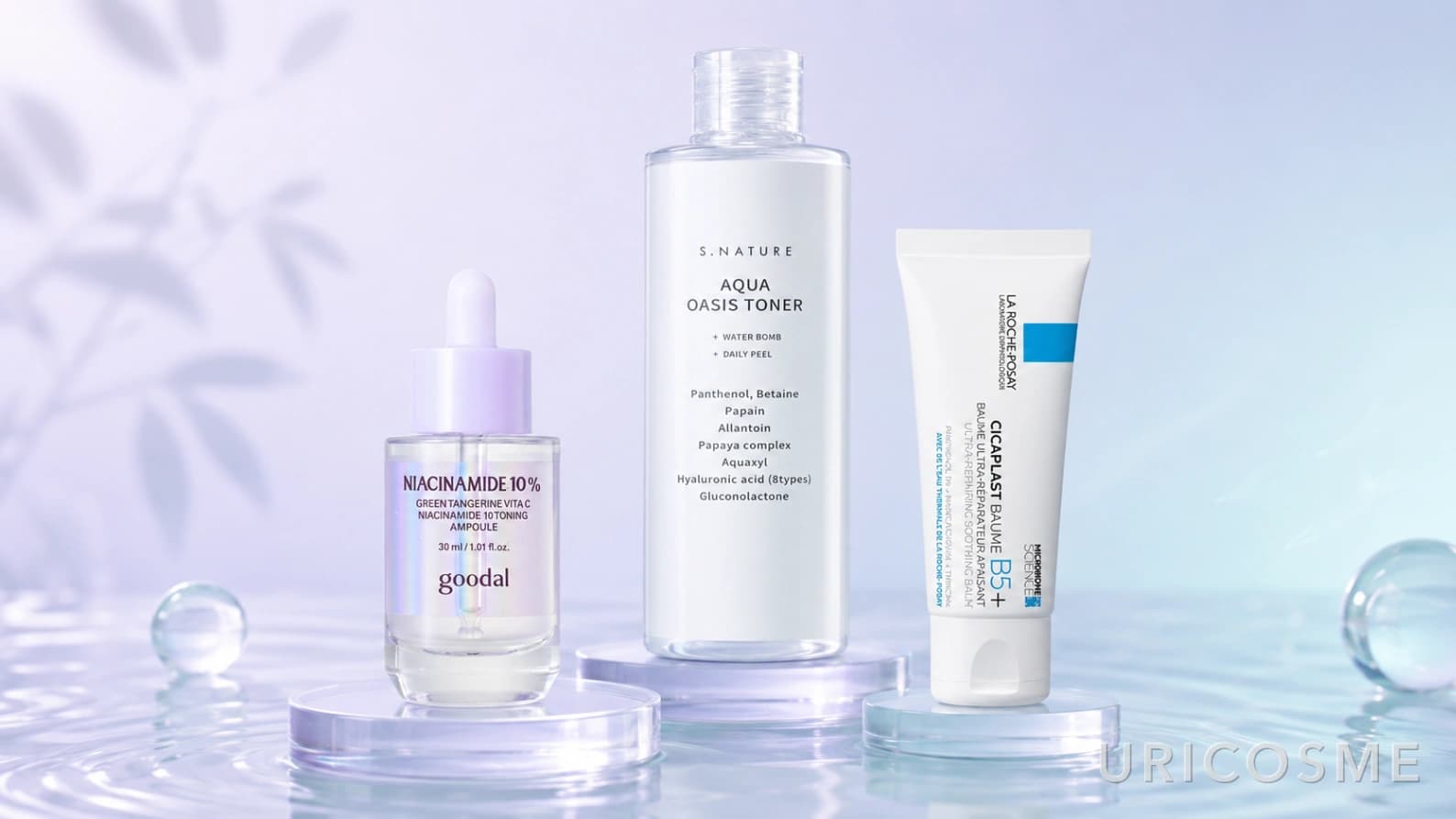
Esnature Aqua Oasis Toner is one example of the format. It is a 300 ml essence toner that pairs hyaluronic acid ingredients such as sodium hyaluronate and hyaluronic acid with glycerin and panthenol. It also contains papain and gluconolactone, mild exfoliating ingredients, so it is worth easing off the amount or frequency on days when skin feels sensitive.
Press toner in with your hands instead of scrubbing with a cotton pad, which is gentler on dry skin. If one layer does not settle the tightness, move on to serum and cream rather than piling on five more layers.
Step 2. One serum chosen for your main concern
Pick a serum for the concern that bothers you most right now, not for your age. If fine lines and texture come first, retinol is the usual starting point. If dark spots and dullness come first, a vitamin C serum makes more sense.
Retinol for fine lines and texture
Retinol is a vitamin A derivative used for fine lines, uneven texture and pigmentation. Starting daily, or starting with a high percentage, is the fastest way to end up with dryness and stinging instead of results.
Beginners generally do better with a low concentration used two or three nights a week, increasing frequency only once skin has clearly adapted. Follow it with enough moisturizer, and be thorough with sunscreen the next morning.
If your skin is very dry, or you deal with significant redness or inflammation, talk to a dermatologist before starting. Retinoids should be avoided during pregnancy. American Academy of Dermatology guidance on retinol
Vitamin C for dark spots and dull tone
For melasma-adjacent discoloration, post-acne marks and skin that reads dull, a vitamin C serum is worth considering. Goodal Green Tangerine Vita C Niacinamide 10 Ampoule, sold in some markets as the Toning Ampoule, is one K-beauty option in this category: its ingredient list combines tangerine extract with niacinamide, ascorbic acid and 3-O-ethyl ascorbic acid.
Vitamin C can be used in the morning, but only with sunscreen over it. If it is new to you, start with a lower concentration or a gentler derivative, and cut back on frequency if you get stinging or redness.
Using retinol and vitamin C together
If both are new to you, do not add them in the same week. Splitting them, vitamin C in the morning and retinol at night, or alternating days, makes it far easier to identify what caused any irritation.
Step 3. A barrier cream that keeps moisture in
In your 40s, holding water in matters as much as putting it there. When you shop for a cream, read the ingredient list before you read the word "repair" on the front of the box.
- Ceramides
- Panthenol
- Glycerin
- Squalane
- Shea butter
- Petrolatum
For a denser balm-type finish, La Roche-Posay Cicaplast Baume B5+ comes up often. Its panthenol-containing formula is used to lay down an occlusive layer over dry or compromised skin.
That said, not every "repair" cream regenerates skin cells or meaningfully rebuilds collagen. What a cosmetic moisturizer reliably does is keep skin hydrated and create conditions in which a damaged barrier can recover.
Sunscreen matters more than any new cream
You can replace your toner, serum and cream and still see limited results on spots and aging if sun protection is missing. The American Academy of Dermatology lists daily broad-spectrum sunscreen as the single most basic way to reduce premature skin aging. AAD guidance on reducing premature skin aging
Apply it even on indoor days if you spend hours near a window, and reapply at regular intervals when you are outside for long stretches.
Checklist before you replace anything
Turning 40 is not a reason to throw out products that still work. These are the changes worth acting on.
- Skin stays tight for a long time after cleansing.
- Your current cream no longer holds up by the afternoon.
- Makeup clings to dry patches and texture feels rougher.
- You want to work specifically on fine lines or dark spots.
- A product you have been using now stings or leaves skin flushed.
Change one product at a time instead of several at once. If your skin is sensitive, patch testing on the inner arm for 7 to 10 days before using something on your face is a reasonable extra step.
Frequently asked questions
Do I have to replace all my skincare once I turn 40?
No. If what you use is still comfortable, keep it. Swapping one step at a time, when you notice a real change such as lasting tightness after cleansing or dryness by mid-afternoon, costs less and puts less strain on your skin.
Can I use retinol every night?
It is safer to begin with a low concentration two or three nights a week and watch how your skin responds. If you get dryness, flaking or stinging, space out applications and use more moisturizer. Retinoids should be avoided during pregnancy.
Can I use retinol and vitamin C on the same day?
If both are new to you, do not start them together. Use vitamin C in the morning and retinol at night, or alternate days, so you can tell which one caused any irritation.
Is an essence toner better than a regular toner?
It depends on your skin. If you get significant tightness after cleansing, a more hydrating essence type can help. If you are oilier, a lightweight toner finished with a cream may feel better. Judge the routine as a whole rather than the texture of one product.
Will a repair cream get rid of wrinkles?
A cosmetic moisturizer will not erase wrinkles that have already formed. Its role is to keep skin hydrated and support an environment where the barrier can recover. For fine lines, the realistic approach is consistent hydration and sun protection, with an active such as retinol added slowly.
Change one product at a time
Skincare in your 40s is not about price. It is about hydration, one targeted active, barrier support and sun protection. Refill water with an essence toner, choose retinol or vitamin C based on the concern that bothers you most, and finish with a barrier cream.
Add daily sunscreen on top of that and you have a routine simple enough to actually keep. Today, change only the one product that is bothering you most.
Sources
- American Academy of Dermatology, Retinoid or retinol?
- American Academy of Dermatology, How to reduce premature aging skin
This article provides general information about skincare. Product formulas, full ingredient lists and directions can change, so check the seller's latest information before you buy and use anything. If you have a skin condition or irritation that persists, consult a dermatologist.


